
Always code as if the guy who ends up maintaining your code will be a violent psychopath who knows where you live. [Rick Osborne]
Showing posts with label programming. Show all posts
Showing posts with label programming. Show all posts
Sunday, February 15, 2015
Top 5 Programming Languages That Are In Demand By Employers
With the entire buzz about learning to code and how programming is the new superpower, it become imperative to know at least one of the programming languages so as to gain a leeway over others. Even if you are not a novice, and already have some knowledge of programming than also it is quite fruitful to know which language is having the maximum traction in the tech world.
Also Read: Top IT Certification Programs for Beginners in 2014
Also Read: List of Biggest and Popular Programming Contests
Are you a developer looking to polish your coding skills? Or you must be a novice caught in midst of the current wave of learn-to-code, looking for a language skill that can provide you reliable employment in the New Year. With so many programming languages out there it can be daunting task for even a seasoned professional to decide which one is the best for making a career. Here are listed 5 programming languages that will remain as a top employable skill for a long time to come.
Java
Easily one of the most important programming languages of the modern computing era, Java is a higher level language that was designed by James Gosling of Sun Microsystems, and released in 1995. The biggest benefit of Java has been its “Write once, run anywhere,” (WORA), meaning that the code written once can be used multiple times on multiple platforms. This is the reason that Java is the first preference for developing most enterprise applications.
Today, Java is one of the most popular languages, having around 10 million developers, creating client-server web applications. Even after being around for more than 15 years, and emergence of many other languages, Java is yet to witness any decline in its popularity, a part of which can be credited to its secure features. Java also happens to be one of the most well paid programming skills, with a Java developer earning an average annual base salary of $95,000.
SQL
Structured Query Language is a specialized programming language that was designed for managing data in relational database management systems (RDBMS). It is a fourth generation language, originally developed by IBM in early 1970s and has since undergone multiple changes over the course of time. The average salary of a person trained in SQL is around $90,000 and the top employers include big names like Microsoft, Dell, Disney, Amazon, UnitedHealth Group, Amazon amongst others.
C
C is one of the oldest programming languages still in wide usage and still continues to remain the most popular, according to the Tiobe Programming Community Index. A number of other new languages such as C#, Java, Python, PHP and Perl have borrowed concepts from C. The powerful, stable and easy availability of its libraries make C a reliable choice to fall back upon.
It also serves as the introduction to the world of programming, as learning C makes it easier to learn other languages. The average salary of a candidate with expert skills in C is around $93,000. Most C programmers spend their time creating highly complex applications such as video games, and high-frequency trading apps.
Also Read: 6 Tools to make JavaScript Development a Cakewalk
Also Read: 6 FAQs on Graphic Designing as a Career
Python
Python is a high level language, created by Guide van Rossum as a successor to ABC language. It was designed keeping in mind the human readability limitations, which is the reason that it doesn’t take as much code to execute a particular function as it does in other programming languages. It is an object-oriented language that developers can put to use in many different ways.
The streamlined syntax makes it easier for newbie programmers to pick up the concepts, and also encourages them to take it up as a career. With internet explosion, use of Python has picked up pace for creation of web based apps. Currently it powers some of the most popular websites of the world, which includes names like Instagram.com, and Pinterest.com, amongst others. Python developers can expect to earn anything in the range of $83,000 annually.
PHP
PHP (Hypertext Processor) is a server side scripting language popular in web development. Easy to learn, PHP powers more than 244 million websites, including the top content management systems WordPress, Joomla, Drupal amongst others. The relatively young language has found favor owing to its ability of being easily embeddable within the codes of HTML. Learning PHP is indispensable for someone who is looking to make a full time career out of web development. There are a huge number of employment opportunities for individual with skills in PHP programming.
Learning to code in 2014 should be one of your resolutions for the New Year.
Author Bio:
Saurabh Tyagi took to writing at a tender age of ten, when he submitted his first essay for the school magazine. He is also a hobbyist programmer, going as far as pursuing multiple courses in the popular programming languages.
Thursday, February 12, 2015
Top 10 Popular Programming Languages of All Time
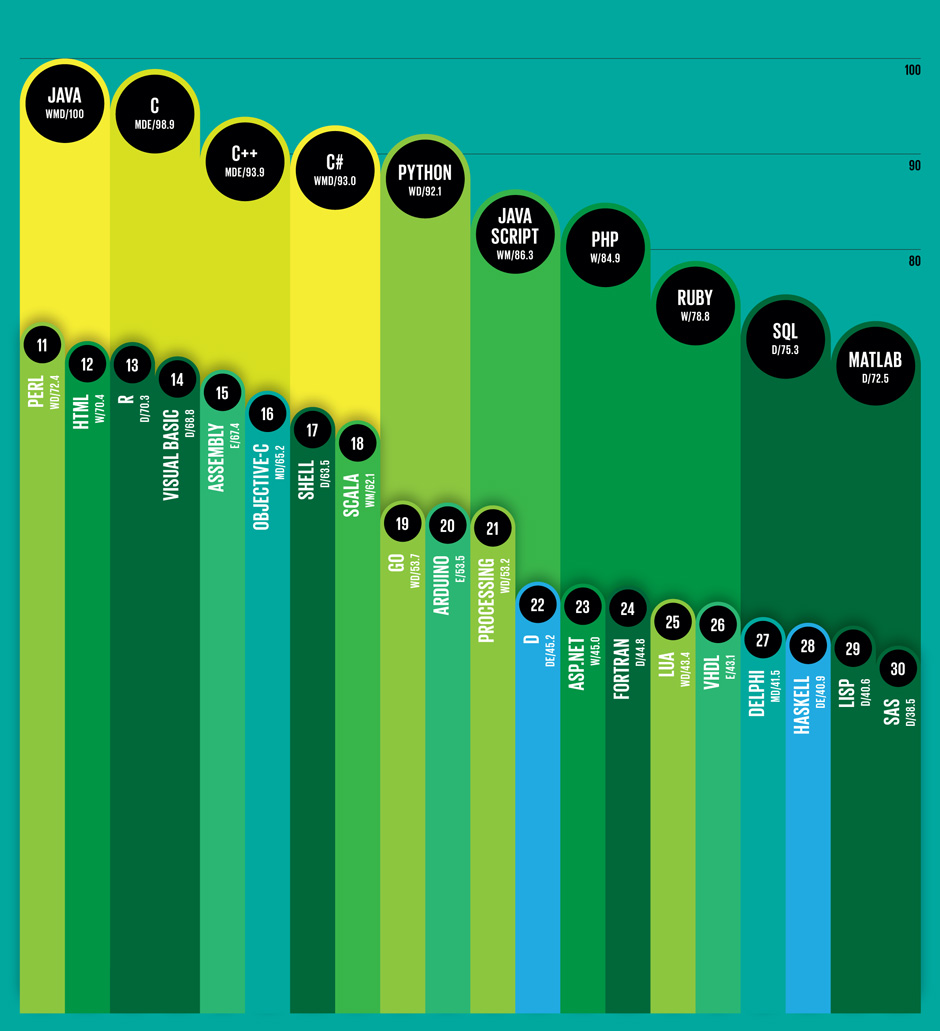
In this article I am giving the list of top 10 popular programming languages which was shared by IEEE Spectrum. The ranking of these languages are based on 12 metrics that are Google search, Stack Overflow, Hacker News, Reddit, Career Builder, Google trends, Github, Dice, Topsy, and IEEE Xplore. Java language is at first position while MATLAB at tenth. This list also contains popular programming languages that are ranked from 11th to 30th position. So if you are thinking to learn a programming language and start your career in programming then this list can help you to find the best.
Also Read: List of Biggest and Popular Programming Contests
Also Read: Top 5 Programming Languages That Are In Demand By Employers
Also Read: List of Biggest and Popular Programming Contests
Also Read: Top 5 Programming Languages That Are In Demand By Employers
List of Top 10 Popular Programming Languages
 |
| (Click on the image to enlarge) |
Source: http://spectrum.ieee.org/computing/software/top-10-programming-languages
Tuesday, February 3, 2015
Programming lessons I wish I knew when I graduated part 1
Ive been writing code for about ~13 years. Ive had jobs in the software industry since 9th grade: while my friends spent summers slaving away at their McJobs, I was in an air conditioned office browsing the web. I got my BS and masters from a good CS department, consistently ranked top 5 in the nation. Despite all that, when I got to the "real world", I absolutely, positively, unconditionally, sucked.
 |
| Actually, I still suck, but Im much more aware of it now and am actively doing something about it |
There are many things about "professional" software engineering that you just cant learn in school. This post will go through several hard lessons that every programmer must eventually learn or remain in perpetual suck-land forever. This list certainly isnt comprehensive, but hopefully itll help some newbie programmer out there so s/he can suck just a little less when its time to go "pro".
1. Maintenance
The nature of being a student is that most projects are short lived: you spend a few nights on it before the assignment is due, hand it in, and never think about it again. In the professional world, its often the opposite. When an employer asks you to build something, remember: they are also asking you to maintain it. Possibly forever.
Just about every company is mired in "legacy" code that has been around for years and someone gets the soul-sucking work of keeping it running. Try not too laugh too much when you see it: before long, your own contributions will be part of the mess that someone else is maintaining. Once you start dealing with this crud on a daily basis, youll learn the true value of writing clear, understandable and maintainable code. Dont cry too much when you come across some horrendous pile of spaghetti code, tear your hair out to understand it, curse the author and his whole family... only to come to the realization that it was something you scrawled together 6 months ago.
Pro tip: learn that programming is part engineering and part writing. You must write code that can be understood by two audiences: the computer and your fellow programmers.
2. Testing
Whenever you are tempted to type something into a print statement or a debugger expression, write it as a test instead. [Martin Fowler]
Programming is hard. Really hard. Some people cant do it at all. And of those who claim they can, they often suck at it, badly. Given how difficult it is to produce correct code, it is all the more appalling to find programmers who barely test what they write. Ive seen people refactor classes, modify hundreds of lines of code, totally rework core pieces of logic and then check-in with no more than a cursory glance at the output. This is horrifying.

Part of the problem is that programming education is often based around manual testing: run this, click that, and if the output looks correct, youre done. It makes sense to do this in an intro level CS course, as its hard to write code to test your code if you dont know how to, er, code. However, once you get beyond this beginner stage, I dont think any university course, coding tutorial, or book should ever encourage or accept manual testing again. For example, Id love for every CS course to require each project to include an automated test suite: you are graded not just on the correctness of your code, but also on the (very related) issue of the effectiveness of your tests.
Pro tip: get really good at writing automated tests. They are the "healthy diet and regular exercise" of software engineering.
3. You dont know what you dont know
On two occasions I have been asked, "Pray, Mr. Babbage, if you put into the machine wrong figures, will the right answers come out?" In one case a member of the Upper, and in the other a member of the Lower House put this question. I am not able rightly to apprehend the kind of confusion of ideas that could provoke such a question. [Charles Babbage]
I came out of school and thought I knew almost everything I needed to know to be a successful programmer. I oozed overconfidence. In reality, the gaps in my knowledge were so huge that I didnt even know what was missing. I was not just a carpenter who only knew how to use a hammer, I didnt even know that screw drivers, pliers, or saws existed. And I was a worse programmer for it.
Oddly enough, finishing school was just the beginning of the learning process. Every new programming language I learned, every new technology I mastered, and each new problem I solved didnt just add a single item to my toolbelt: it exponentially increased the range of problems that I could solve and the efficiency with which I solved them.
Pro tip: you cant predict the benefits of learning something until you actually learn it. The only way to become a great programmer is to take the plunge and try to learn just about everything you can. Read all the blogs and books you can find and get involved with open source as soon as possible.
To be continued...
Continue on to part 2 of this series to learn about screwing up, how to get things done and how to be recognized for it.
Subscribe to:
Posts (Atom)